For internationally qualified nurses and midwives, the Outcome‐Based Assessment (OBA) pathway under AHPRA is the gateway to registration in Australia. A important part of this pathway is the OSCE (Objective Structured Clinical Examination) — a practical exam designed to test clinical skills, communication, and professional judgment in a simulated environment.
While both nurses and midwives complete an OSCE, the content and competencies assessed are different. Understanding these differences is essential for proper preparation and success.
What is the OBA Pathway?
The OBA Pathway is designed to ensure that internationally qualified practitioners meet the same standards as those trained in Australia. It consists of two parts:
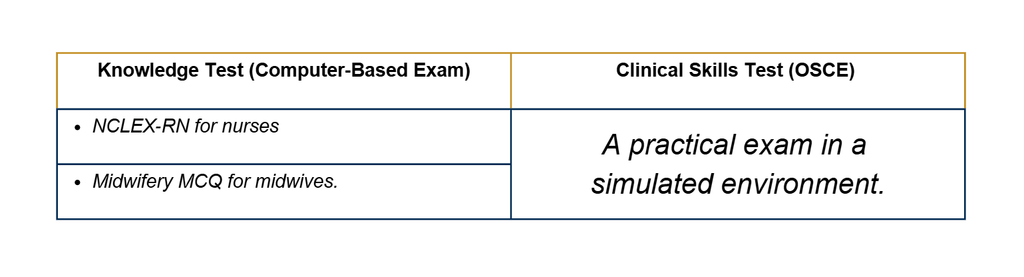
The OSCE is the final step, confirming that candidates can apply their knowledge safely and effectively in real‐world scenarios.
The Role of the OSCE in the OBA Pathway
The OSCE ensures that internationally qualified practitioners can demonstrate safe, effective, and professional practice in line with Australian standards. Candidates rotate through a series of stations, each designed to test specific skills under exam conditions.
The OSCE also evaluates communication, documentation, and decision‐making, reflecting the realities of practice in Australia.
Nursing OSCE

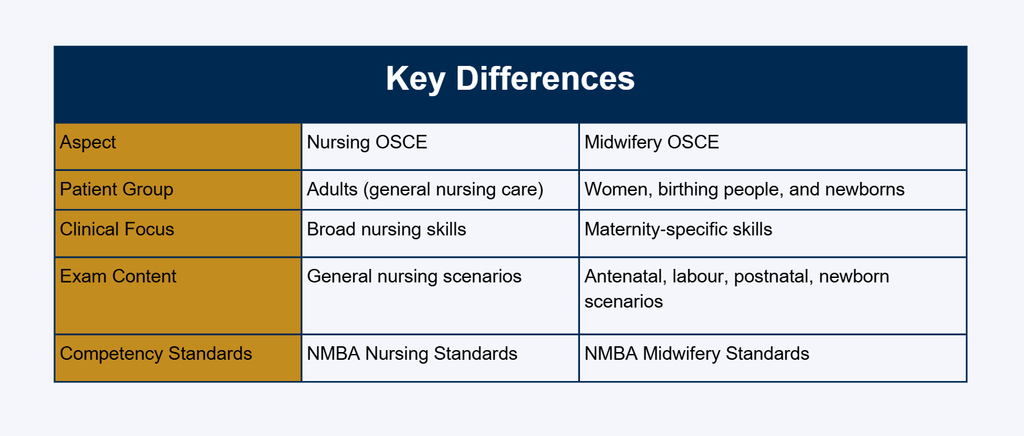
The Nursing OSCE focuses on general nursing practice across adult patient care.
Candidates are assessed on:
- Patient assessment and clinical reasoning
- Medication administration and safety protocols
- Infection prevention and wound management
- Communication and documentation
- Managing deteriorating patients and escalation of care
This exam ensures nurses can deliver safe, evidence‐based care across diverse clinical settings.
Midwifery OSCE

The Midwifery OSCE is specialised in maternity care. It evaluates a candidate’s ability to provide safe, woman‐centred and newborn‐centred care. Skills assessed include:
- Antenatal assessments and health promotion
- Labour support and intrapartum care
- Immediate newborn care and resuscitation
- Postnatal assessments and breastfeeding support
- Communication with women, families, and multidisciplinary teams
Unlike the Nursing OSCE, the Midwifery OSCE is entirely focused on the continuum of pregnancy, birth, and postnatal care.
Why This Matters
- Different Pathways: Nurses cannot sit the midwifery OSCE, and midwives cannot sit the nursing OSCE.
- Preparation Programs: Training must be tailored to the specific OSCE type.
- Career Outcomes: Passing the correct OSCE ensures registration in the right profession under AHPRA.
- Confidence & Clarity: Understanding the difference helps candidates prepare effectively and avoid confusion.
How AuRNPathway Helps?
At AuRNPathway, we understand these differences and provide tailored review programs for both Nursing and Midwifery OSCEs. Our training is designed to help internationally qualified nurses and midwives:
📚 Practise with structured modules aligned to AHPRA standards
🏥 Experience mock OSCEs in simulated exam conditions
🧑🏫 Learn from expert educators with real‐world nursing and midwifery experience
🎯 Receive personalised feedback to strengthen performance
🤝 Join a supportive community of candidates preparing for the same journey
👉 Ready to take the next step? Read more about our OSCE review courses here and discover how AuRNPathway can support your journey to AHPRA registration.